


When I first heard Reagan’s voice talking about tariffs last week on a TV commercial and how “over the long run such trade barriers hurt every American worker and consumer,” leading to “fierce trade wars” and result in lost jobs, I thought by gosh, the Dems had grown a pair. But the ad was produced by province of Ontario, Canada and hit so hard, Trump immediately demanded the Canadian government take it down and penalized them with more tariffs. One wonders why it is our friends from the North were the ones reminding Americans of what this country used to stand for.
With St. Elmo’s Fire back in theaters for its 40th Anniversary last week, I have been thinking about when I first went out to Hollywood when Reagan was in office and a “Politics and the Media” class I took at Duke which was really my film education. The course was taught by Professor David L. Paletz, author of the seminal textbook Media Power Politics, now recognized as a visionary in the field. But back then, the course was truly unique. The first page of the 35-page syllabus explained the purpose of the class was “to explore, analyze, and illuminate many of the relationships between authority and the media of mass communications.” Readings included V. I. Lenin’s What Is To Be Done? J.S. Mill’s On Liberty, de Tocqueville’s Democracy in America and The Grand Inquisitor section from Dostoevsky’s The Brothers’ Karamazov. The films we saw which Paletz had to show us on a projector in the days before videos, DVDS or streaming, ranged from Eisenstein’s 1925 Soviet propaganda film Strike to the Marx Brothers’ Duck Soup to Leni Riefenstahl’s Triumph of the Will credited with helping Hitler rise to power. (For that, Paletz had us read an article in which she claimed she was just an artist and all she had was “boots” to work with.)
Paletz himself was one of those larger-than-life professors whose British accent added to his enigmatic air with a pension for wearing black turtle necks and who rumor had it, in his younger days living in L.A. had hung out with comedian Lenny Bruce. He taught us to think critically of the way media influenced politics which seemed particularly relevant when I was in school as we had a B-movie actor who co-starred with a monkey in Bedtime for Bonzo in The White House. Today with a Reality Star as our President, Paletz’s class even more prescient.
Last November, recalling my “Politics and the Media” lessons, I wrote a Substack talking about how the ads being run about “Kamala is for they/them, Donald Trump is for you” could turn the election in Trump’s favor. On his Weekly podcast, Jon Stewart recently suggested to DNC Chair Ken Martin that his party use that ad against the current administration such as: “Donald Trump is working for you… if you are a tech billionaire or member of the Trump family who according to Forbes magazine have increased their net worth $3 billion. But what about the rest of Americans struggling amidst rising prices in everything from groceries to health care?”
It’s not like the Trump administration has not given the Democrats material with masked men taking away crying mothers from their babies and the East Wing of “The People’s House” being bulldozed to make way for a corporate sponsored ballroom.
Amidst a government shutdown with the Trump administration taking every opportunity to brand as “Democratic-led”, why aren’t the Dems fighting back by running ads that demand instead of giving $40 billion to Argentina, the government use some of the tariff money they have collected to provide relief to American farmers and small businesses who have been suffering because of these policies?
Instead of playing it safe with press conferences the public tune out, they could get creative like with this School House Rock-ish video character actor Jason Kravitz did about Project 2025. That has 1.7 million views on Youtube. The Democratic leadership may be old, but even our 79 year old President has not only heard of TikTok, but been savvy enough to have a presence on it.
There is a high stakes test case playing out right now in Pennsylvania that will be decided next week. I first heard about this after playing tennis when I went to get a snow cone in a park and there was a small gathering around a picnic table. A woman was speaking who turned out to be one of the state’s Supreme Court justices Caroline Donohue. She talked about how a MAGA billionaire who was the richest man in the state was stealing a page from the Musk playbook and targeting her and two other justices. She explained they were trying to persuade voters in a retention election, which was normally a “gimme.” to vote “No” to giving them new terms. The New York Times had an article shortly after on Why A Pennsylvania Court Election in November Could Matter in 2028. Then I started seeing relentless ads during the evening news saying: “Defend our Democracy” talking about these liberal justices had overturned the conviction of a sexual predator and how it was time to impose term limits and get rid of these justices.
The Democrats eventually responded with ads to “Defend Our Courts”,talking about how they would protect abortion which appeals to their base. But I wondered why have they ceded the ground to MAGA on “Defending Our Democracy” and not gone after the obvious opening of the charge of being soft on pedophiles with Trump’s refusal to release the Jeffrey Epstein files and his not ruling out pardoning Ghislaine Maxwell. With the Pennsylvania courts being one of the stopgaps that kept Donald Trump from trying to overturn the 2020 election, this seemed like a chance to elevate the stakes of this election and energize the Democrats to fight not just for the courts, but for democracy itself. They could have run an ad with one of the justices saying:
You probably don’t know me, but I am a Justice for Pa’s Supreme Court. And I wouldn’t be speaking to you if this was just about me and my fellow justices who are being targeted by PA’s richest billionaire on November 4th. I come from the state where the Declaration of Independence was signed that articulated principles Americans have died for, and that, until now have guided our 250 years as the first and most successful democracy in the world. I’m from Pittsburgh, the place which built America with its steel from the Empire State Building to The Golden Gate Bridge and was the Silicon Valley of the Industrial Revolution. We had billionaires too— Carnegie, Mellon and Heinz were wealthier than Musk, Bezos, and Zuckerburg combined, but they gave back because they felt an obligation to the country that made them. Today, the billionaire pals of this current administration are funding a campaign to vote No to retain our Supreme Court Judges. They are spending millions on this because they see a chance to do what they could not do before, and steal our democracy. I am asking you to join the fight, take a stand and show PA and the world what this country stands for.
Instead, the Democrats seem to be going with a familiar playbook with millions of dollars of ads talking about how these justices are protecting your rights. Perhaps they are playing it safe because only one judge has ever lost retention in a race like this in 2005. But these are different times. And meanwhile, on youtube, a longhaired conservative activist who by appearances might be associated with the Democrats is talking to a crowd about how angry they are, and that they are going to channel their anger into voting “NO’ and getting rid of the 3 Supreme Court Justices. Anger is an emotion MAGA knows how to tap into while the Dems continue to play politely.
On November 4th we will which side has been more effective.
There is a good reason Paletz showed us Duck Soup in his Politics and The Media class and people are sharing Charlie Chaplin’s speech from The Great Dictator with fervor. Paletz taught us how comedy can be subversive to the powers that be. There is evidence of how that can translate into action with Volodymyr Zelenskyy. a comedian in the Ukraine, using the title of his satirical TV show, Servant of the People, as the name of his political party.
One of the few wins the opposition to the current administration can point to is when Jimmy Kimmel was taken off the air and millions of people canceled their subscriptions to Disney. The recent “No Kings Protest” showed the thirst there is to take a stand. Scott Galloway on his Pivot podcast with Kata Swisher which mixes tech, politics and humor, has suggested someone organize a modern version of an economic strike so the Democrats talk to be accompanied by action. Couldn’t that be used to remind Americans how much damage is being caused by the shutdown and the chainsaw to important government workers like air traffic controllers and ones trying to protect our health at the CDC. Meanwhile, if you are a Democrat-leaning small D or big D, you just wait for the next South Park episode to drop to feel better.
My TikTok feed just showed me an interview Esra Klein did with Jared Abbott, the Director of the Center for Walking Class Politics, talking about a new study that showed the same candidates running in Rust Belt states like Ohio and Michigan, got a 10 to 15 point penalty for having a D (Democrat) next to their name than an I (independent.) Interestingly, Pennsylvania so far has been an exception. Abbot said how the Democrats are perceived as being out of touch, ineffectual, and unable to deliver on solving problems of the everyday Americans.
For “Politics and The Media,” we had to read Lenin’s “What is To Be Done” where in 1902, that Russian insurgent laid out key points of a revolution, with one of them being using a newspaper as a means to united local struggles into a national movement. One wonders why the Democrats aren’t more focused on theit own media strategy?
I have some experience with the Democrats successfully using media to rebrand themselves. In the 1990s, I applied some of what I had learned in “Politics and the Media” when I reached out to the campaign of a young Governor from Arkansas who seemed to have a different point of view from the stale politicians that seemed to be parroting old talking points. I was living in L.A. at the time and ended up at a fancy legal office where myself and others were shown ads that looked like something for a new Ford vehicle. I became involved with other young people who worked in film and TV with what we called “the DL21C media committee” and with some funding from a then little known J.B. Pritzker, ended up making ads targeted at a new generation of young people.
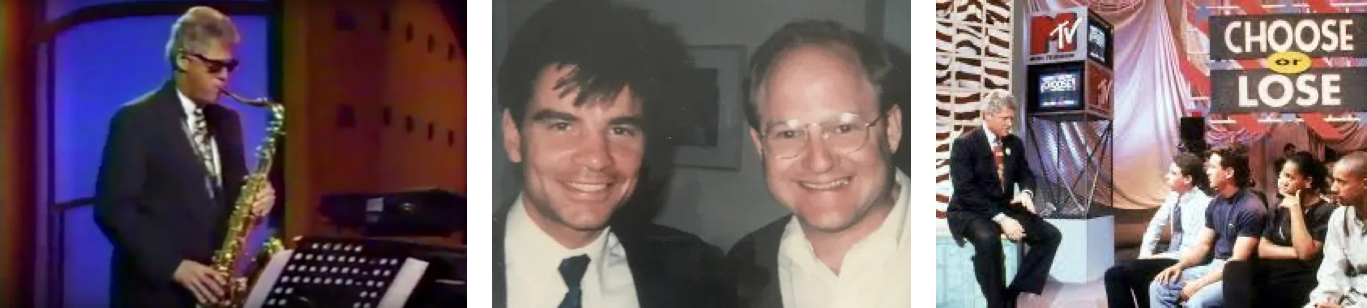
I also wrote a memo about how Bill Clinton should go on MTV to not only reach out to young voters, but show older voters he was a different kind of candidate. When the campaign came to L.A., one of my pushy Hollywood friends grabbed it from me and asked me who should give it to. I pointed to the tall James Carville, but instead he gave it to the short George Stephanopoulos who was standing behind him. George had been a fan of St. Elmo’s Fire and upon reading the memo, thought these were good ideas. Carville at the time barked at me that “young people don’t vote,” (though in fairness, he eventually came around.) When Clinton dropped to third place after the New Hampshire primary, George called me and said they were booking the Governor on The Arsenio Hall Show and MTV. (Google “Clinton” and saxophone” and “Clinton and boxers or briefs”— though these days, something else might come up.)
All this ended up taking me to Little Rock during the campaign where I saw what they called “The War Room,” a rapid-response media team that made sure no charges from the opposition were left unanswered. On Election Night, George crossed over to me and. told me young people had made the difference in the election. I visited George a few months later in The White House where he helped me get President Clinton to tape an anti-smoking message fort a Saved By the Bell episode. A few months later, it was announced George himself was headed to ABC.
I realize this is all ancient history, but I mention it again because it is time for those who want to see different results not only to think about the policies they want to see enacted and their Project 2028, but also to think of a different media strategy. Maybe revive the old War Room so that there is a rapid-response team so much that is misinformation go unanswered. Of course, in this age of social media, all of that would also have to be reinvented. And this effort would have to overcome that the one thing Americans seem to trust less than Democrats is “the media.”
What really won me my internship from Duke University to Universal Studios was not the St. Elmo’s Fire short story I wrote in college, but a movie I made for “Politics and The Media.” In one of his classes, Paletz showed us two films made about quintuplets. First was ABC News Reports the Fischer Quintuplets, an uplifting look at how the birth of these five new babies had been a blessing not just to this modest farm couple and the small town of Abeerdeen, South Dakota. The second film was Happy Mother’s Day appeared to be more cinema verité, but where the filmmakers Richard Leacock and Joyce Chopra edited the film to reveal that Mrs. Fischer was wary of the furs and the rest of the gifts being thrust at the “happy couple,” and that Mr. Fischer, a dairy farmer, was clearly not happy with a local dairy company offering them a lifetime supply of milk.
For my final project, I pitched Paletz this idea of filming a lecture of his class and editing it several different ways. Paletz smiled wryly, and said, he was too smart to fall for that. I found another of my professors, Lawrence Goodwyn, author of The Populist Moment, who agreed. With my friend Rob Cohen (later to inspired the Andrew McCarthy character in St. Elmo’s,) we filmed Larry, as Goodwyn insisted we call him, as he preached to his class about democracy with a small “D” and a movement that needed to organize in order to give power back to “the people.”
I edited the first version to make Professor Goodwyn look like a benevolent democratic leader, one to make him look like a despotic autocratic, an alternate ones where he seemed fascist, but incompetent, and then as a dictator-like, but effective. Paletz gave me an A minus for the end product because in each version, no matter what reaction shots I used, Goodwyn still came across as a bit bombastic. Paletz said I had proven the limitations of the medium.
Thinking of it now, I realize there are limitations to what media can do. You still need compelling candidates who can articulate a vision. Democrats still have to focus on substance and what they would do different to address real problems. But my old professor David Paletz definitely saw the future when he called his book “Media Power Politics.”
For the record, Paletz always favored the genius of Buster Keaton versus Chaplin who became more famous in the silent era. The Great Dictator was made in 1939 as Hitler was on the move in Europe. Chaplin plays a Jewish barber who is mistaken for the brutal fascist dictator Adenoid Hynkel, who is trying to expand his empire. This was the first time Chaplin actually spoke on film.